new zealand vacation, accomodation, travel information, flight, car rental

Monday, May 07, 2007

Heartbeat of a Giant - Lake Wakatipu, Queenstown

According to Maori legend, Lake Wakatipu is the “Hollow of the Giant” (Whakatipua). There was an evil giant in the land and one day while he was asleep, a brave Maori youth set him on fire and killed him. The fire melted the surrounding snow on the mountains to form the water in the lake.

Well, Lake Wakatipu is a giant! With a length of 84 km, it is New Zealand’s longest lake and its 3rd largest lake with an area of 291 km². It has an unsual “Z”-shaped bend, somewhat like the lightning bolt of the Marvel Comics superhero Flash. Some also refer to it as the reversed “N” shape.

My New Zealand Vacation, Queenstown, Lake Wakatipu, Pano143
(click for larger photo)
One end of Lake Wakatipu lies far away in the middle of this photo
Queenstown, Aug 2006
For more info on this photo, click here

One end of the lake is near the Southern Alps where the melt waters become the Dart River that flows into it. At the other end of the lake at Frankton, near Queenstown Airport, the Kawaura River flows out, draining the lake.

My New Zealand Vacation, Queenstown, Lake Wakatipu, Pano138
(click for larger photo)
The Kawaura River flows out of Lake Wakatipu at Frankton
Queenstown, Aug 2006
For more info on this photo, click here

Geologically, the lake was carved out by great glaciers during the ice age. It is very deep, reaching to depths of almost 300m and almost 100m below sea level.

There is also an unusual phenomena at Lake Wakatipu. Every 5 minutes, the water in the lake rise and then fall as much as 12cm. Early Maori noticed this phenomena too and attributed this rhythmic rise and fall to the heartbeat of a giant. There is a scientific explanation for this and putting it simply, it is a natural oscillation that occurs in deep inland lakes.

My New Zealand Vacation, Queenstown, Lake Wakatipu, Pano17a
(click for larger photo)
Queenstown Bay
Queenstown, May 2005

These Maori legends add to the colourful history and beauty of Lake Wakatipu and Queenstown.

Friday, May 04, 2007

Beautiful Queenstown, New Zealand

Of all the many places I have visited (and re-visited) in New Zealand, Queenstown remains my favourite destination. I have been there at least 10 times, nevertheless this place continues to excite me. It is the Adventure Capital of the World but it is not the adrenalin pumping activities that makes me return but the natural beauty of this place.

Being a city dweller, the type of mountains I have known for most part of my life are skyscrapers and highrise buildings. So seeing the majestic mountain ranges of New Zealand and getting on top of one by helicopter, have done wonders for my soul!

I have many photos of the beautiful scenery of Queenstown. Sorting and selecting them to form panoramas have been quite a task! The next couple of postings will feature these scenery and through the photos you will catch a glimpse of the beautiful memories that I have of Queenstown. So here goes:

My New Zealand Vacation, Queenstown, Lake Wakatipu, Pano07a
(click for larger photo)
Early morning in winter
Queenstown, May 2005

Queenstown is located on the shore of Lake Wakatipu and surrounded by majestic mountain ranges. Queenstown Central/CBD (Central Business District) is on the left side in these photos. Across the lake, Cecil Peak is the mountain on the left and Walter Peak is the pyramidal mountain in the centre of these photos.

My New Zealand Vacation, Queenstown, Lake Wakatipu, Pano185a
(click for larger photo)
Early morning in winter
Queenstown, Aug 2006

For a leisurely walk in Queenstown Gardens, head towards the trees on the left side of the lake. On the extreme right, the Skyline Gondola takes you to the top of Bob's Peak (the peak without snow) where you get a bird's eye view of the surrounding region!

My New Zealand Vacation, Queenstown, Lake Wakatipu, Pano152a
(Click for larger photo)
Late morning in winter
Queenstown, Aug 2006

Talking about birds, you will find them along the lakefront. In these photos, you can spot the seagulls and ducks (on the lake). For several years, there was a lone goose that made its home on the Queenstown bay too. Then came another one and they became geese. Last year (2006), I spotted only one of them and I guess the missing one has "flown away to bird heaven".

My New Zealand Vacation, Queenstown, Lake Wakatipu, Pano173a
(click for larger photo)
Dusk in winter
Queenstown, Aug 2006

Along the lakefront, the white vessel is the vintage steamship TSS Earnslaw (it looks quite small in these photos). Everyday, the TSS Earnslaw ferries tourists on a leisurely cruise across the lake from Queenstown bay to the Walter Peak High Country Farm. For an adrenaline pumping ride, then the yellow Kawaura jet boats in these photos will provide your water adventure.

Thursday, April 26, 2007

Wai Ora Spa in Hell's Gate, Rotorua

With these postings on Hell’s Gate and Rotorua, I would be doing injustice not to mention another main attraction that visitors come to Rotoura for: hot springs and spa. There were a couple of options available in Rotorua but I decided to experience something more raw and unique …… and I could play with mud!

At Hell’s Gate, you will find Wai Ora Spa. Hell’s Gate or Tikitere has been known by the local Maori for over 800 hundred years. It is renowned as a place of healing and revitalizing. Besides its sulphurous waters, its specialty is also in its mud! The mud found at Hell’s Gate is very fine (smooth) and it is said to be among the finest in the world. If you are into spa and body mud, you may wish to visit Wai Ora Spa when you are in Rotorua.

My New Zealand Vacation, Rotorua, Hell's Gate, Photo10576
(click for larger photo)
Signpost to Wai Ora Spa
Hell’s Gate, Rotorua, May 2006

This is not the typical commercial spa with enclosed or private rooms. Instead, it is in the outdoor and each pool is separated by wooden partitions which offer little privacy. No skinny dipping or frolicking in the buff! Bring your swimming trunk/costume if you want to enjoy the mud spa. By the way, while I was seated in the pool, Wai Ora staff came in and put a dipstick into the water to measure water temperature.

Each pool is a rectangular concrete pool which holds the warm muddy water. So where was the mud? Well, I had to scoop (or scrape) it from the bottom of the pool with my fingers! There was not much mud to play with but sufficient to coat all over my body. The mud was easy to spread and felt very smooth. After coating myself, I sat on the pool edge to let the mud dry up. It was very late autumn and the wind was a little chilly. So after a while I was back inside the pool to enjoy the warm water, then coating myself with mud again and letting it dry up.

It would have been better if there was more mud in the pool. The mud in Hell’s Gate must be a precious commodity as it is also used in a range of beauty spa products. More in the pool means less products to go around.

When the time came to leave the mud pool, I had to do the unpleasant thing of taking a cold shower to wash off all the mud before heading over to the hot sulphurous pools for a good soak.

The spa was a good experience! I felt really good and relaxed. My skin felt smooth too except that I carried the smell of sulphur for another few more days.

My New Zealand Vacation, Rotorua, Hell's Gate, Photo10762
(click for larger photo)
Signboard – Map of Hell’s Gate
Hell’s Gate, Rotorua, May 2006

Monday, April 23, 2007

Hot Waterfall in Hell's Gate, Rotorua

Within the compound of Hell’s Gate, lies another world of lush greenery that is very different from the landscape of craters, sulphur deposits and boiling pools. A short walk through lush forest and we saw below waterfall. Kakahi Falls is the largest hot waterfall in the Southern Hemisphere. In the past, Maori warriors after battle would bathe in these waters to heal their wounds and remove their “tapu” of war. The sulphurous waters is said to promote the healing of wounds.

My New Zealand Vacation, Rotorua, Hell's Gate, Photo10694
(click for larger photo)
Kakahi Falls
Hell’s Gate, Rotorua, May 2006

Kakahi Falls looks like a nice spot for a relaxing bath. I can imagine the Maori warriors sitting with their backs against the stone walls (see close-up) with the hot water flowing over their bodies. In such a tranquil spot with surrounding greenery and hot water, I would certainly enjoy my bath there too!

My New Zealand Vacation, Rotorua, Hell's Gate, Photo10693
(click for larger photo)
Close-up of Kakahi Falls
Hell’s Gate, Rotorua, May 2006

Friday, April 20, 2007

Muddy Pools, Sulphur Deposits and "Fart" Holes in Hell's Gate, Rotorua

Hell’s Gate will not be complete without a mention of the Devil. Below photo shows a small crater/pool with the signpost tagging it as "Devil’s Cauldron". What was different about this pool from most others, was that it looked murky, muddy and there was an oily film on the water. My guide said perhaps there is oil in the ground!

My New Zealand Vacation, Rotorua, Hell's Gate, Photo10703
(click for larger photo)
Devil’s Cauldron
Hell’s Gate, Rotorua, May 2006

Below photo shows another larger but similarly murky, muddy and oily pool. Look at the other pool in the background. It is an interesting contrast because you can catch a reflection of the sky, clouds and trees in the water. If you are wondering about the yellow "soil" around this muddy pool, yes, these are sulphur deposits.

My New Zealand Vacation, Rotorua, Hell's Gate, Pano54
(click for larger photo)
Another larger pool of "hot chocolate"
Hell’s Gate, Rotorua, May 2006

Below, more photos of sulphur deposits. You will find these throughout the landscape of Hell’s Gate. It is all these sulphur fumes emitting from the ground that gives Hell’s Gate and Rotorua their infamous rotten-egg smell! Do you see the hole in the ground (bottom photo)? The sulphur gases would have been released under much pressure to have caused this hole. Another motivation to stay on the pathway is that we can never know when the ground will release these gases suddenly. Imagine what it would be like to be "farted" at close range! ..... Awesome! ;-)

My New Zealand Vacation, Rotorua, Hell's Gate, Photo10754
(click for larger photo)
Sulphur deposits

My New Zealand Vacation, Rotorua, Hell's Gate, Photo10702
My New Zealand Vacation, Rotorua, Hell's Gate, Photo10701
(click for larger photo)
Beware of "fart" holes!
Hell’s Gate, Rotorua, May 2006

Thursday, April 12, 2007

"Land Coral" in Hell's Gate, Rotorua

One of the unusual things we saw at Hell’s Gate pertains to something called “land coral”. On the guided tour, we got the opportunity to venture out of the pathway with the guide to get a closeup of some interesting sights. If you are self-guided, please stay on the pathway for your own safety as the ground is rather unstable and the Hell’s Gate terrain is filled with craters, boiling mud and boiling ponds!

After the guide had given his safety instructions, he divided the tour into small groups of 3-4 persons each and we made our way in single file behind him. In spite of strict and clear instructions that we were to follow him directly from behind, to walk where he walked, nevertheless the guide saw someone taking a few steps off from his route and he had to ask if the guy understood English at all!

My New Zealand Vacation, Rotorua, Hell's Gate, Pano58
(click for larger photo)
Terrain of craters, boiling mud and boiling ponds!
Hell’s Gate, Rotorua, May 2006

In above photo, the guide (in red) was pointing to a pond where steam was rising from. What we were looking at was the pond in below photo. Along the edge of the pond, was some kind of “deposit” called “land coral”. It seems that this “deposit” was the evidence of a certain form of bacteria that could thrive in such harsh conditions of boiling water and acidity. As the bacteria grew and multiplied, the “deposit” becomes larger. It is fascinating to learn that Nature provides an abundance of life even in such an environment. What would kill a human being was life-giving to a bacteria!

My New Zealand Vacation, Rotorua, Hell's Gate, Pano59
(click for larger photo)
Boiling pond teeming with bacteria life
Hell’s Gate, Rotorua, May 2006

Below two photos show the close-ups of “land coral”.

My New Zealand Vacation, Rotorua, Hell's Gate, Photo10748
My New Zealand Vacation, Rotorua, Hell's Gate, Photo10744
(click for larger photo)
“Land coral”
Hell’s Gate, Rotorua, May 2006

Sunday, April 08, 2007

Mud Volcano at Hell's Gate

Given its unique landscape, Hell’s Gate presents an excellent opportunity for academic learning and research. My guide told us that the geothermal park had even played hosts to student groups from USA and Singapore. These students had spent several days in the park having their field lessons in geography and chemistry.

There have been geologists spending considerable time studying the unique land features in the park too. Below is a mud volcano which is still growing. Hot mud oozes from the ground and builds up to form this mud volcano. Notice the amount of steam in below photo. At the bottom right, you can also spot an impression of a footprint!

My New Zealand Vacation, Rotorua, Hell's Gate, Photo10710
(click for larger photo)
Steaming hot mud volcano
Hell’s Gate, Rotorua, May 2006

Below photo puts the size of this mud volcano in perspective.

My New Zealand Vacation, Rotorua, Hell's Gate, Photo10714
(click for larger photo)
Mud volcano
Hell’s Gate, Rotorua, May 2006

This mud volcano has attracted the attention of a number of geologists. About 2-3 years ago, there was a French volcanologist who was especially interested in it. Unable to contain his curiosity, he got off the designated pathway for a closer look. He wanted to examine the top portion of this mud volcano so he decided to step on it. His initial steps must have been well supported because when he was somewhere in the middle of the volcano, his leg went right through into the mud! What happened thereafter was a frantic rescue. This volcanologist suffered serious burns on his leg and was hospitalized for more than a month!

My New Zealand Vacation, Rotorua, Hell's Gate, Photo10715
(click for larger photo)
Where the volcanologist sank in
Hell’s Gate, Rotorua, May 2006

Above photo shows the side of this mud volcano where this volcanologist sank in. If you are all ready for an adventure in New Zealand, then it would be good to restrain yourself and stay on (not stray off) the path in Hell’s Gate. You wouldn’t want to spend your New Zealand vacation in hospital, would you? Instead, keep your adventure spirit and put it to good use when you are in Queenstown, which is the Adventure Capital of the World.

Thursday, April 05, 2007

Staying On The Path Inside Hell's Gate

Unlike Wai-O-Tapu, Hell’s Gate looks more raw and rough and it lacks the commercial development of a typical New Zealand tourist site. Its natural landscape looks uniquely different too.

If you have not got used to the sulphurous odour of Rotorua, then you may find the rotten egg (or fart!) smell here too overpowering. Hell's Gate claims to be the most geothermally active field and you are right in the heart of stink country with all these fumes around you! Well, one good thing is that you can fart here and no one can smell the difference in the air quality! Looking at these photos, you will find that Hell's Gate will be the steamiest part of your vacation in New Zealand. Besides visiting these geothermal parks, do plan to enjoy Rotorua's tourism appeal as a spa destination too.

My New Zealand Vacation, Rotorua, Hell's Gate, Pano57
(click for larger photo)
Unique landscape of this geothermal park, with lots of steam & smell too!
Hell’s Gate, Rotorua, May 2006

There are lots of interesting land features to look at. However, do heed the warning signs and stay on the path at all times. The whole area is rather unstable and you never know when the ground beneath your feet will collapse!

My New Zealand Vacation, Rotorua, Hell's Gate, Photo10700
(click for larger photo)
Big stink-hole, the ground looks deceivingly stable and firm!
Hell’s Gate, Rotorua, May 2006

Above crater is just about 1.5-2m away from the pathway. The guide told us that this steaming big hole had suddenly appeared one morning. He had guided a tour group along the pathway in the morning and the ground at that spot had appeared normal. By afternoon when his fellow colleague guided another tour, they discovered this big gaping hole in the ground. It would have been a disaster if the ground had collapsed and someone had fallen into the boiling mud beneath!

My New Zealand Vacation, Rotorua, Hell's Gate, Pano55
(click for larger photo)
Staying on (not straying off) the path!
Hell’s Gate, Rotorua, May 2006

It took 6 photos to compose above panorama. If you are on the guided tour, you may get the opportunity to venture out of the pathway with the guide to see some interesting features at close up. Remember the prayer/chant that the Maori guide said at the waharoa and watch your step!

Wednesday, April 04, 2007

Entering Hell's Gate

Entering Hell's Gate, the visitor will pass beneath a wooden Maori archway called a waharoa. It contains elaborate carvings and tells the legend of the early Maori chief who settled here and whose descendants today own Hell's Gate.

My New Zealand Vacation, Rotorua, Hell's Gate, Photo10756
(click for larger photo)
Waharoa
Hell's Gate, Rotorua, May 2006

If you join the guided tour, the group will first stop in front of the waharoa to listen to the legend. Afterwhich, the Maori guide will say a short prayer/chant for the blessing and protection of the group before entering Hell's Gate. While some may feel uncomfortable about this, believe me, it is a very good way to get the attention of everyone to watch their steps the moment they are inside Hell's Gate! You will do well to heed the warning signs in this place.

My New Zealand Vacation, Rotorua, Hell's Gate, Photo10757
(click for larger photo)
Welcome signboard explaining the Waharoa
Hell's Gate, Rotorua, May 2006

A Steamy Vacation in Rotorua !

How about spending a steamy vacation in New Zealand? That’s what playwright George Bernard Shaw did in his visit to Rotorua in 1934! He must have been awed by the landscape of boiling mud pools, steaming fumeroles and caught a glimpse of what he thought hell would look like that he gave a geothermal reserve its famous name “Hell’s Gate”.

My New Zealand Vacation, Rotorua, Hell's Gate, Pano49
(click for larger photo)
Your kind of steamy vacation ?
Hell’s Gate, Rotorua, May 2006

Hell’s Gate Geothermal Reserve covers 50 acres and claims to be the most active geothermal field in Rotorua. It is also the only Maori owned geothermal reserve in the Rotorua / Taupo region. It’s Maori name, Tikitere is an abbreviation of “Taku tiki i tere nei” which means “my daughter has floated away”. The legend concerns Maori princess Hurutini who threw herself into a boiling pool in this place because her husband had treated her with contempt. Hurutini’s mum was very upset by her daughter's death and seeing her body afloat on the water. Hence, the name Tikitere.

My New Zealand Vacation, Rotorua, Hell's Gate, Pano52
(click for larger photo)
Another steamy photo
Hell’s Gate, Rotorua, May 2006

Tuesday, April 03, 2007

The Grandfather at Wai-O-Tapu, Rotorua

The following are some of the interesting features found in Wai-O-Tapu. The Oyster Pool is named after its distinct shape and it is one of the smallest pools in this geothermal park.

My New Zealand Vacation, Rotorua, Wai-O-Tapu, Photo10581
(click for larger photo)
Oyster Pool
Wai-O-Tapu, Rotorua, May 2006

Below Frying Pan Flat is an eruption crater with an unstable floor. The pool is characterized by lots of bubbling hot springs and fumeroles. The water flows from the Champagne Pool, crosses this Frying Pan Flat to emerge as a stream that flows into Lake Ngakoro.

My New Zealand Vacation, Rotorua, Wai-O-Tapu, Pano22
(click for larger photo)
Frying Pan Flat
Wai-O-Tapu, Rotorua, May 2006

Below panorama was composed from 6 photos. From the right, the water flows from the Frying Pan Flat, tumbles across the rocks and ends as Lake Ngakoro Waterfall which empties into the green waters of Lake Ngakoro, The Grandfather. Lake Ngakoro covers about 12 hectares and was formed after an eruption about 700 years ago. Notice the rough rock edges along the stream as well as the rocks littering the edge of the lake.

My New Zealand Vacation, Rotorua, Wai-O-Tapu, Pano14
(click for larger photo)
Lake Ngakoro Waterfall
Wai-O-Tapu, Rotorua, May 2006

It was raining and misty on my day of visit last May. I will surely revisit Wai-O-Tapu to see it in bright sunny weather when its brilliant colours are at their best. The thought of my next vacation to New Zealand gets me excited again! Look out for my next posting as I will introduce another interesting place in Rotorua.

Monday, April 02, 2007

Where the "Devil" Lives and Bathes at Rotorua

At Wai-O-Tapu, you will see the Devil’s Home. It is a collapsed crater which underground acid action has caused the ground to give way. You can see the grooves and rough edges caused by the acid erosion. The yellow/green colours on the walls of the crater are caused by the sulphurous fumes arising from beneath , the ground.

My New Zealand Vacation, Wai-O-Tapu, Rotorua, Photo10543
(click for larger photo)
Where the “Devil” lives
Wai-O-Tapu, Rotorua, May 2006

I took this photo from another angle which shows a tunnel at the side of this crater. I guess this is where the acidic water had flowed out and caused the ground to collapse.

My New Zealand Vacation, Rotorua, Wai-O-Tapu, Photo10544
(click for larger photo)
The tunnel leading to the “Devil”
Wai-O-Tapu, Rotorua, May 2006

The Devil’s Bath is a large crater and it is an amazing green colour! It took 4 photos to compose below panorama. Where the “home” is a drained-out crater, the “bath” is filled up and it is a result of excess water from the Champagne Pool mixing with the sulphur and ferrous salts in the ground to give the pool its amazing colour.

My New Zealand Vacation, Rotorua, Wai-O-Tapu, Pano12
(click for larger photo)
Where the “Devil” bathes
Wai-O-Tapu, Rotorua, May 2006

Primrose Terrace and Bridal Veil Falls at Wai-O-Tapu, Rotorua

The Primrose Terrace is a landform created by silica deposits. Covering an area of 3 acres, it is the largest in New Zealand since the famed Pink and White Terraces were destroyed in the eruption of Mt Tarawera in 1886. The Primrose Terrace is formed by water from the Champagne Pool which contains dissolved silica. As the water evaporates, the silica is left on the ground. It is a very gradual process of formation, very much like how stalactites and stalagmites are formed. It is estimated that the Primrose Terrace have been forming over the past 700 years since the last major geothermal activity in Wai-O-Tapu.

My New Zealand Vacation, Rotorua, Wai-O-Tapu, Pano19
(click for larger photo)
The Primrose Terrace on the left side of the boardwalk
Wai-O-Tapu, Rotorua, May 2006

On the left side of the boardwalk, the Primose Terrace is relatively flat with a down slope gradient. Towards the end of the boardwalk, the slope becomes more prominent. Below photo continues with the view of Primrose Terrace after the boardwalk crossing.

My New Zealand Vacation, Rotorua, Wai-O-Tapu, Photo10562
(click for larger photo)
The Primrose Terrace
Wai-O-Tapu, Rotorua, May 2006

It may not be apparent in above photo but there is only a thin layer of water trickling over the silica deposits. The graduated lines of the terraces can be seen in the foreground of above photo and the formation follows the pattern of water trickling down slope.

The Primrose Terrace ends with a drop and as seen in below photo, there is no longer any graduated lines of the terraces but an uneven splattering of deposits. Where this drop begins, the silica deposits has been named the Bridal Veil Falls and we can see why it was named as such.

My New Zealand Vacation, Rotorua, Wai-O-Tapu, Pano15
(click for larger photo)
Bridal Veil Falls
Wai-O-Tapu, Rotorua, May 2006

Sunday, April 01, 2007

Champagne Pool at Wai-O-Tapu, Rotorua

One of the most photographed sections of Wai-O-Tapu is the Champagne Pool. It gets its name from the constant bubbling of its water. The water fizzles and reminds of champagne though its colour is a tinge of blue and green. Along the edge of the lake, is a brilliant shade of orchre.

My New Zealand Vacation, Rotorua, Wai-O-Tapu, Pano13
(click for larger photo)
Champagne Pool
Wai-O-Tapu, Rotorua, May 2006

Unfortunately, the day I was there, it was raining and the raindrops and runoffs into the the pool had made the water murky. Otherwise, on a sunny day, the colours in the photos would have turned out brilliant!

Champagne Pool is the largest spring in the area. It has a diameter of 65m and is 62m deep! It’s surface temperature is 74 degrees Celsius and steam constantly arises from the pool. The bubbles in the pool are due to carbon dioxide, just like champagne! Like all the natural features in Wai-O-Tapu, Champagne Pool was formed by geothermal activity. From the nearby rocks found at the embankment, it is believed that the pool was formed by a hydrothermal eruption 700 years ago.

My New Zealand Vacation, Rotorua, Wai-O-Tapu, Pano19
(click for larger photo)
Crossing the Primrose Terrace on the boardwalk
Wai-O-Tapu, Rotorua, May 2006

Across the boardwalk, on the right side where the steam arises, the blue & orange shade of water indicates where the Champagne Pool is.

On the extreme right side is Artist’s Palette. When water overflows from the Champagne Pool, it brings with it minerals which are deposited on this side of the pool which results in a multitude of colours in the water. Hence, this side of the pool has been named Artist’s Palette.

On the left side of the boardwalk lies the Primrose Terrace which I will mention more in a subsequent posting.

Friday, March 30, 2007

Lady Knox Geyser at Wai-O-Tapu, Rotorua

There are two main geyser attractions at Rotorua: The Whakarewarewa Thermal Park and the Wai-O-Tapu Thermal Wonderland.

At Whakarewarewa, among the other geysers, the star is Pohutu which means “Big Splash” in Maori. If you wish to see the greatest geyser in New Zealand, then this is the one. It erupts as many as 20 times a day and reach up to heights of 30 metres. Within this thermal park, you will see bubbling mud and hot thermal springs too. If you would like to experience Maori culture too, the New Zealand Maori Arts and Crafts Institute is located in the park. You will see skilled Maori carvers and flax weavers at work. There are concert performances in the evening and you can get to experience the hangi, the traditional Maori earth oven meal.

The other main geyser attraction is at the Wai-O-Tapu Thermal Wonderland. I chose Wai-O-Tapu because besides the geyser, I had wanted to see the colourful pools and lakes of this geothermal area.

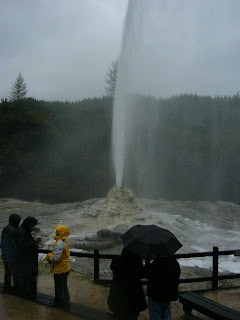
At Wai-O-Tapu, I was all excited to see the Lady Knox Geyser because it erupts daily at about 10:15am, reaching up to heights of 20 metres. It is amazing to know that even Nature has its own bio-rhythm and “clock” and keeps rather precise time too.

My New Zealand Vacation, Rotorua, Wai-O-Tapu, Lady Knox Geyser, Photo10525
(click for larger photo)
Lady Knox Geyser minutes before she blows
Wai-O-Tapu, Rotorua, May 2006

As 10:15am approached, a park warden/guide walked into the enclosed area and stood in front of the geyser. I thought it was foolish of the guide to have done that because we can never be sure of the exact moment the geyser blows. In spite of safety precautions, we should never trifle with this hot shower system. The guide went on to explain about the phenomena of geysers and this guy acted so coolly as if he had eyes behind his head to keep watch on the geyser!

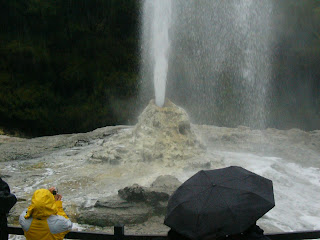
It was then he revealed that someone discovered soap powder could enhance the buildup of pressure and activity which causes the geyser to erupt! This discovery could have been made by convicts who in the past were using the water for their bathing and washing. The guide proceeded to pour soap powder into the mouth of the geyser and a few moments later, Lady Knox began to regurgitate and then she finally blew up.
My New Zealand Vacation, Rotorua, Lady Knox Geyser, Photo10531
(click for larger photo)
Lady Knox Geyser blows after taking in a mouth of soap powder
Wai-O-Tapu, Rotorua, May 2006

Without soap powder, Lady Knox will not be blowing at 10:15am every day. Left on its own, its cycle varies and the interval of its next eruption could be as much as 1.5 days later.
My New Zealand Vacation, Rotorua, Lady Knox Geyser, Photo10532
(click for larger photo)
Lady Knox Geyser blows at full force
Wai-O-Tapu, Rotorua, May 2006

It was spectacular watching the force of water coming out from Lady Knox but I could not help feeling kind of cheated. Human kind has once again interfered with nature for the sake of tourism dollars! However, the amazing colours of the pools and lakes in Wai-O-Tapu more than made up for this disappointment.

Thursday, March 29, 2007

Wai-O-Tapu Thermal Wonderland, Rotorua

Wai-O-Tapu means “sacred waters” in Maori. For many tourists, the colours of the pools and lakes in Wai-O-Tapu are simply amazing!

My New Zealand Vacation, Rotorua, Wai-O-Tapu, Photo10600
(click for larger photo)
Amazing colour of a pool
Wai-O-Tapu, Rotorua, May 2006

Covering 18 square km, Wai-O-Tapu is covered with collapsed craters, cold and boiling pools of mud, water and steaming fumeroles. Beneath the ground, streams are constantly heated by magma and water has been recorded at up to temperatures of 300 degrees Celsius! The water is so hot that it absorbs minerals out of the rocks and passes out as steam at the surface which is ultimately re-absorbed into the ground. The wide range of colours of the pools and lakes in Wai-O-Tapu are due to the rich mineral content in the waters.

My New Zealand Vacation, Rotorua, Wai-O-Tapu, Photo10547
(click for larger photo)
Collapsed crater
Wai-O-Tapu, Rotorua, May 2006

Rotorua – Geothermal Hotspot

In terms of geothermal activity, Rotorua ranks as one of the most active hotspots in the world. At one of the thinnest sections, the Earth’s crust is only about 17km thick and beneath it, molten magma!

The two main attractions that people come to Rotorua to experience are its geothermal activity and Maori culture. Rotorua is a city of about 53,000 people and of which a third is Maori. The city is located on the southern shore of Lake Rotorua. In fact, Lake Rotorua with a diameter of 16 km is the circular depression of a massive volcano! If you get your hands on a topographic map, you would recognize this feature of the land. Being at Rotorua, I would not have realized this at all. So while at this city, I was actually walking and sleeping on the rim of a massive volcano! This Rotorua “volcano” is one of several large volcanoes in the Taupo region. It is estimated to have last erupted about 140,000 years ago and the magma chamber had collapsed to result in the Lake Rotorua we see today.

My New Zealand Vacation, Rotorua, Photo10521
(click for larger photo)
Hot, bubbling mud pool
Rotorua, May 2006

The attractions of Rotorua mainly revolve around hot thermal springs, geysers, bubbling mud pools and other geothermal features. You will know you will soon arrive at Rotorua when you smell a rotten-egg odour in the air! This pervasive smell is due to the sulphur fumes which arise from all these geothermal activity. You may find this smell overpowering initially and it kind of makes your head woozy. Not to worry, you will soon get used to it and perhaps you will even crack some jokes about the smell too. My coach driver was joking about passengers boarding the coach and giving him funny looks because they must be thinking that he has been farting on the trip! Kiwi humuor. :-)

My New Zealand Vacation, Rotorua, Photo10523
(click for larger photo)
Bubbling mud, contributing its share of “fart” smell in Rotorua
Rotorua, May 2006

Wednesday, March 28, 2007

Giants of the Puketi Kauri Forest

The main purpose of my vacation to the Northland in May 2006 was to see the giant Kauri tree. I had read about it and just had to see one for myself. As recent as two hundred years ago, there were still large tracts of these Kauri forests throughout New Zealand, especially in North Island. However, the arrival of the European settlers in the 1800s led to massive logging and decimated much of these ancient forests. The Kauri tree was prized for its huge size and strength of its timber and these qualities made it especially suitable for ship building. A mature Kauri tree is bare of branches at its trunk, except at its crown, so this made it particularly attractive for use as the masts of sailing ships.

The Kauri tree is a coniferous tree. Like the giant Sequoia tree of North America, the Kauri tree can grow to become a very large tree and it can live beyond a thousand years! A mature Kauri can grow to heights of 40-50 metres with trunk diameters of 3-4 metres. A young Kauri is characerised by branches along its trunk which gives it a shape of a cone (hence coniferous tree). As it grows, it continually sheds its lower branches. At maturity, branches are found only at its crown and the mature Kauri is characterized by its imposing trunk that is bare of branches.

Today, the largest area of mature Kauri forest is found in Waipoua Forest in Northland. It is a 2,500 hectare forest which contains three quarters of remaining New Zealand Kauri. The largest living Kauri, named after the Maori god Tane Mahuta, which means “God of the Forest”, has a height of 51m, trunk diameter of 4.4m and a girth of 13.3m ! Te Matua Ngahere, which means “Father of the Forest”, is believed to be the oldest living Kauri and estimated to be more than 2,000 years old! Some of the larger Kauri trees felled in the past could be older than Te Matua Ngahere.

My New Zealand Vacation, Kauri Tree, Pano34
(click for larger photo)
Giant Kauri 600-800 years old, trunk bare of branches
Puketi Kauri Forest, May 2006

Instead of Waipoua Forest, I had visited Puketi Forest to see these giant trees. That morning had begun with rain and mist. Fortunately, the mist had started to clear up when we made our way into the forest. My original photos of these trees did not turned out well and resulted in the blurred effect. I am a little disappointed that this is the best photo I have of these Kauri giants. This Kauri tree is estimated to be 600-800 years old and compared to Te Matua Ngahere, it would only be a teenager! Nevertheless, it was a great experience to have met and be awed by a living thing this old !

If you want another glimpse of the giant Kauri tree, turn on your speakers, click here for the video and don’t wait too long before you experience your magical New Zealand vacation:

100% Pure ! video (click here)

Tuesday, March 27, 2007

World Famous Mangonui Fish and Chips Shop, Doubtless Bay

Mangonui is located at the Doubtless Bay region of Northland. Once a bustling and busy whaling port, today it retains its charm as a quaint fishing village with many of its historic buildings housing restaurants, cafes, gift shops and the post office. Interestingly, Mangonui means “big shark” in Maori. However, it is not shark or its fishing industry that draws many tourists and Kiwis here but fish and chips! The star attraction is its world famous Mangonui Fish and Chips Shop which is sited along the main road and enjoys especially good business from the tour coaches.

My New Zealand Vacation, Mangonui Fish and Chips, Pano324
(click for larger photo)
World Famous Mangonui Fish and Chips Shop
Mangonui Village, May 2006

This shop has the reputation of having been voted several times as the best fish and chips in New Zealand! As it is also a fish shop which serves the locals with fresh fish every day, I guess its “secret” lies in the freshness of the fish. I quite enjoyed its fish and chips and the order came with a generous serving of chips. Usually, being famous means a premium price but the price was reasonable at this shop (though I can’t recall how much I paid for the meal).

As a fish shop, it offers many varieties of fresh fish. You will get to select which type of fish to go with your chips. You will given an order number while your meal is being cooked. Many of the tours stop at this place so be prepared to wait for your food but you will get enough time to enjoy your meal. You may wish to dine on the deck which overlooks the harbour.

I had the time to wander along the road to enjoy this peaceful scenic view. There were a few albatrosses in the air that afternoon. They would glide slowly in the air, gain some height and then suddenly plunging down into the water with a “smack”, to emerge later from the water (could even see the fish in their beaks in some instances) and then flying off. It was kind of enchanting to see them do that again and again. The memory that Mangonui left with me was that of the albatrosses gliding overhead in this peaceful scenic place and less of the fish and chips in my tummy!

My New Zealand Vacation, Mangonui Village, Pano323
(click for larger photo)
Mangonui Village, May 2006
Want more info? Search Google!
Google
the web this blog