new zealand vacation, accomodation, travel information, flight, car rental
Showing posts with label wai-o-tapu. Show all posts

Tuesday, April 03, 2007

The Grandfather at Wai-O-Tapu, Rotorua

The following are some of the interesting features found in Wai-O-Tapu. The Oyster Pool is named after its distinct shape and it is one of the smallest pools in this geothermal park.

My New Zealand Vacation, Rotorua, Wai-O-Tapu, Photo10581
(click for larger photo)
Oyster Pool
Wai-O-Tapu, Rotorua, May 2006

Below Frying Pan Flat is an eruption crater with an unstable floor. The pool is characterized by lots of bubbling hot springs and fumeroles. The water flows from the Champagne Pool, crosses this Frying Pan Flat to emerge as a stream that flows into Lake Ngakoro.

My New Zealand Vacation, Rotorua, Wai-O-Tapu, Pano22
(click for larger photo)
Frying Pan Flat
Wai-O-Tapu, Rotorua, May 2006

Below panorama was composed from 6 photos. From the right, the water flows from the Frying Pan Flat, tumbles across the rocks and ends as Lake Ngakoro Waterfall which empties into the green waters of Lake Ngakoro, The Grandfather. Lake Ngakoro covers about 12 hectares and was formed after an eruption about 700 years ago. Notice the rough rock edges along the stream as well as the rocks littering the edge of the lake.

My New Zealand Vacation, Rotorua, Wai-O-Tapu, Pano14
(click for larger photo)
Lake Ngakoro Waterfall
Wai-O-Tapu, Rotorua, May 2006

It was raining and misty on my day of visit last May. I will surely revisit Wai-O-Tapu to see it in bright sunny weather when its brilliant colours are at their best. The thought of my next vacation to New Zealand gets me excited again! Look out for my next posting as I will introduce another interesting place in Rotorua.

Monday, April 02, 2007

Where the "Devil" Lives and Bathes at Rotorua

At Wai-O-Tapu, you will see the Devil’s Home. It is a collapsed crater which underground acid action has caused the ground to give way. You can see the grooves and rough edges caused by the acid erosion. The yellow/green colours on the walls of the crater are caused by the sulphurous fumes arising from beneath , the ground.

My New Zealand Vacation, Wai-O-Tapu, Rotorua, Photo10543
(click for larger photo)
Where the “Devil” lives
Wai-O-Tapu, Rotorua, May 2006

I took this photo from another angle which shows a tunnel at the side of this crater. I guess this is where the acidic water had flowed out and caused the ground to collapse.

My New Zealand Vacation, Rotorua, Wai-O-Tapu, Photo10544
(click for larger photo)
The tunnel leading to the “Devil”
Wai-O-Tapu, Rotorua, May 2006

The Devil’s Bath is a large crater and it is an amazing green colour! It took 4 photos to compose below panorama. Where the “home” is a drained-out crater, the “bath” is filled up and it is a result of excess water from the Champagne Pool mixing with the sulphur and ferrous salts in the ground to give the pool its amazing colour.

My New Zealand Vacation, Rotorua, Wai-O-Tapu, Pano12
(click for larger photo)
Where the “Devil” bathes
Wai-O-Tapu, Rotorua, May 2006

Primrose Terrace and Bridal Veil Falls at Wai-O-Tapu, Rotorua

The Primrose Terrace is a landform created by silica deposits. Covering an area of 3 acres, it is the largest in New Zealand since the famed Pink and White Terraces were destroyed in the eruption of Mt Tarawera in 1886. The Primrose Terrace is formed by water from the Champagne Pool which contains dissolved silica. As the water evaporates, the silica is left on the ground. It is a very gradual process of formation, very much like how stalactites and stalagmites are formed. It is estimated that the Primrose Terrace have been forming over the past 700 years since the last major geothermal activity in Wai-O-Tapu.

My New Zealand Vacation, Rotorua, Wai-O-Tapu, Pano19
(click for larger photo)
The Primrose Terrace on the left side of the boardwalk
Wai-O-Tapu, Rotorua, May 2006

On the left side of the boardwalk, the Primose Terrace is relatively flat with a down slope gradient. Towards the end of the boardwalk, the slope becomes more prominent. Below photo continues with the view of Primrose Terrace after the boardwalk crossing.

My New Zealand Vacation, Rotorua, Wai-O-Tapu, Photo10562
(click for larger photo)
The Primrose Terrace
Wai-O-Tapu, Rotorua, May 2006

It may not be apparent in above photo but there is only a thin layer of water trickling over the silica deposits. The graduated lines of the terraces can be seen in the foreground of above photo and the formation follows the pattern of water trickling down slope.

The Primrose Terrace ends with a drop and as seen in below photo, there is no longer any graduated lines of the terraces but an uneven splattering of deposits. Where this drop begins, the silica deposits has been named the Bridal Veil Falls and we can see why it was named as such.

My New Zealand Vacation, Rotorua, Wai-O-Tapu, Pano15
(click for larger photo)
Bridal Veil Falls
Wai-O-Tapu, Rotorua, May 2006

Sunday, April 01, 2007

Champagne Pool at Wai-O-Tapu, Rotorua

One of the most photographed sections of Wai-O-Tapu is the Champagne Pool. It gets its name from the constant bubbling of its water. The water fizzles and reminds of champagne though its colour is a tinge of blue and green. Along the edge of the lake, is a brilliant shade of orchre.

My New Zealand Vacation, Rotorua, Wai-O-Tapu, Pano13
(click for larger photo)
Champagne Pool
Wai-O-Tapu, Rotorua, May 2006

Unfortunately, the day I was there, it was raining and the raindrops and runoffs into the the pool had made the water murky. Otherwise, on a sunny day, the colours in the photos would have turned out brilliant!

Champagne Pool is the largest spring in the area. It has a diameter of 65m and is 62m deep! It’s surface temperature is 74 degrees Celsius and steam constantly arises from the pool. The bubbles in the pool are due to carbon dioxide, just like champagne! Like all the natural features in Wai-O-Tapu, Champagne Pool was formed by geothermal activity. From the nearby rocks found at the embankment, it is believed that the pool was formed by a hydrothermal eruption 700 years ago.

My New Zealand Vacation, Rotorua, Wai-O-Tapu, Pano19
(click for larger photo)
Crossing the Primrose Terrace on the boardwalk
Wai-O-Tapu, Rotorua, May 2006

Across the boardwalk, on the right side where the steam arises, the blue & orange shade of water indicates where the Champagne Pool is.

On the extreme right side is Artist’s Palette. When water overflows from the Champagne Pool, it brings with it minerals which are deposited on this side of the pool which results in a multitude of colours in the water. Hence, this side of the pool has been named Artist’s Palette.

On the left side of the boardwalk lies the Primrose Terrace which I will mention more in a subsequent posting.

Friday, March 30, 2007

Lady Knox Geyser at Wai-O-Tapu, Rotorua

There are two main geyser attractions at Rotorua: The Whakarewarewa Thermal Park and the Wai-O-Tapu Thermal Wonderland.

At Whakarewarewa, among the other geysers, the star is Pohutu which means “Big Splash” in Maori. If you wish to see the greatest geyser in New Zealand, then this is the one. It erupts as many as 20 times a day and reach up to heights of 30 metres. Within this thermal park, you will see bubbling mud and hot thermal springs too. If you would like to experience Maori culture too, the New Zealand Maori Arts and Crafts Institute is located in the park. You will see skilled Maori carvers and flax weavers at work. There are concert performances in the evening and you can get to experience the hangi, the traditional Maori earth oven meal.

The other main geyser attraction is at the Wai-O-Tapu Thermal Wonderland. I chose Wai-O-Tapu because besides the geyser, I had wanted to see the colourful pools and lakes of this geothermal area.

At Wai-O-Tapu, I was all excited to see the Lady Knox Geyser because it erupts daily at about 10:15am, reaching up to heights of 20 metres. It is amazing to know that even Nature has its own bio-rhythm and “clock” and keeps rather precise time too.

My New Zealand Vacation, Rotorua, Wai-O-Tapu, Lady Knox Geyser, Photo10525
(click for larger photo)
Lady Knox Geyser minutes before she blows
Wai-O-Tapu, Rotorua, May 2006

As 10:15am approached, a park warden/guide walked into the enclosed area and stood in front of the geyser. I thought it was foolish of the guide to have done that because we can never be sure of the exact moment the geyser blows. In spite of safety precautions, we should never trifle with this hot shower system. The guide went on to explain about the phenomena of geysers and this guy acted so coolly as if he had eyes behind his head to keep watch on the geyser!

It was then he revealed that someone discovered soap powder could enhance the buildup of pressure and activity which causes the geyser to erupt! This discovery could have been made by convicts who in the past were using the water for their bathing and washing. The guide proceeded to pour soap powder into the mouth of the geyser and a few moments later, Lady Knox began to regurgitate and then she finally blew up.
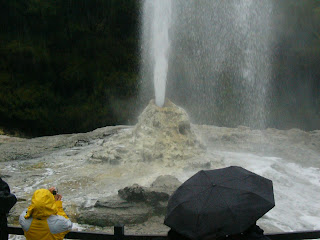
My New Zealand Vacation, Rotorua, Lady Knox Geyser, Photo10531
(click for larger photo)
Lady Knox Geyser blows after taking in a mouth of soap powder
Wai-O-Tapu, Rotorua, May 2006

Without soap powder, Lady Knox will not be blowing at 10:15am every day. Left on its own, its cycle varies and the interval of its next eruption could be as much as 1.5 days later.
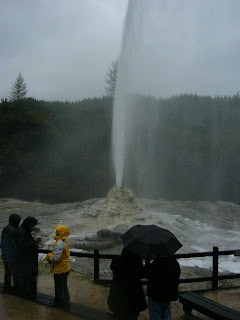
My New Zealand Vacation, Rotorua, Lady Knox Geyser, Photo10532
(click for larger photo)
Lady Knox Geyser blows at full force
Wai-O-Tapu, Rotorua, May 2006

It was spectacular watching the force of water coming out from Lady Knox but I could not help feeling kind of cheated. Human kind has once again interfered with nature for the sake of tourism dollars! However, the amazing colours of the pools and lakes in Wai-O-Tapu more than made up for this disappointment.

Thursday, March 29, 2007

Wai-O-Tapu Thermal Wonderland, Rotorua

Wai-O-Tapu means “sacred waters” in Maori. For many tourists, the colours of the pools and lakes in Wai-O-Tapu are simply amazing!

My New Zealand Vacation, Rotorua, Wai-O-Tapu, Photo10600
(click for larger photo)
Amazing colour of a pool
Wai-O-Tapu, Rotorua, May 2006

Covering 18 square km, Wai-O-Tapu is covered with collapsed craters, cold and boiling pools of mud, water and steaming fumeroles. Beneath the ground, streams are constantly heated by magma and water has been recorded at up to temperatures of 300 degrees Celsius! The water is so hot that it absorbs minerals out of the rocks and passes out as steam at the surface which is ultimately re-absorbed into the ground. The wide range of colours of the pools and lakes in Wai-O-Tapu are due to the rich mineral content in the waters.

My New Zealand Vacation, Rotorua, Wai-O-Tapu, Photo10547
(click for larger photo)
Collapsed crater
Wai-O-Tapu, Rotorua, May 2006
Want more info? Search Google!
Google
the web this blog